Understanding Growing Degree Days (GDDs) for Lawn Care
If you are new to lawn care or looking to refine your maintenance schedule, growing degree days (GDDs) are a vital tool. Simply put, GDDs measure heat accumulation, a proxy for plant growth, based on daily temperatures. They help predict when plants, like grass, will begin growing, enabling precise timing of your applications, whether it is fertiliser, herbicides, or plant growth regulators (PGRs).
How GDDs Work
GDDs are calculated by taking the average of the daily high and low temperatures, subtracting a base temperature, typically 0°C, 6°C, or 10°C depending on your grass type and summing them over time. Essentially, when your lawn surpasses a set GDD threshold, growth begins.
When to Use GDDs for PGR Applications
PGRs are crucial for controlling excessive growth, especially on fine turf. Rather than applying them on a fixed schedule, GDDs allow you to apply them precisely when the grass is ready. After your initial PGR application, you can set an alert, for example, at 500 GDDs and then at 700 GDDs, ensuring steady growth suppression, reducing waste, and preventing over-application. We generally follow 200 GDD between PGR applications in New Zealand.
 Introducing Our App: GDD Tracker
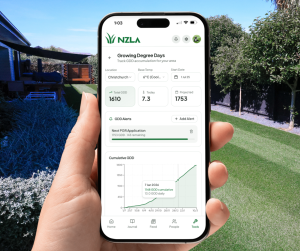
We have built a tool to make managing GDDs effortless. Once you enter your location, the app prompts you to select warm-season or cool-season turf. From your personalised start date, when your lawn emerges from dormancy, GDDs accumulate daily. In the app, you receive alerts when key thresholds are reached, so you never miss a step, whether you are scheduling PGR applications or other lawn treatments. Find the NZLA App here.
Custom Start Dates for New Zealand’s Climate
New Zealand is a country of diverse climates. Instead of a one-size-fits-all approach, you set your own start date based on your region. As the grass wakes up in your area, GDDs accumulate. Within the app, you see daily GDDs, and notifications keep you on track. Whether you are planning PGR applications or other lawn treatments, you stay ahead of the curve.
Why 0°, 6°, and 10° Bases Matter
In many parts of the world, such as America, 0° is often used as the base temperature. However, in New Zealand, we use 6° and 10° bases because they align better with our grass types and growth patterns. Cool-season grasses often respond best at 6°, while warm-season grasses align with 10°. This gives you a more accurate measure of growth, tailored to New Zealand conditions.
When Should You Start Tracking Growing Degree Days
In simple terms, you begin when your lawn begins actively growing. Not when the calendar says spring, and not when you feel like it should be growing, but when temperatures consistently support growth and you see genuine movement in the lawn.
For cool season lawns in much of New Zealand, that usually means when winter dormancy has clearly broken. You are mowing regularly again, colour is returning, and growth is consistent rather than patchy. That is the logical point to enter your start date in the app and begin accumulating GDD using a 6°C base.
For warm season lawns such as kikuyu or couch, you would typically wait until you see active lateral spread and vertical growth resuming after winter. At that point, using a 10°C base, you set your start date and allow GDD to accumulate from there.
There is no single national start date because New Zealand’s climate varies significantly between regions. Northland will move weeks ahead of Canterbury or Otago. Coastal areas behave differently to inland zones. That is why we have not locked in a fixed start date in the app. You control it based on what your lawn is actually doing.
How Our GDD Tracking Differs From Traditional Calculators
Many traditional growing degree day calculators are designed to reset back to zero after each application. For example, you apply a PGR, then the counter restarts so you can track accumulation toward the next application interval. That system works, and it is widely used.
We have taken a slightly different approach. In our app, GDD continues accumulating throughout the season, so you can see the full picture of heat accumulation across the year. Instead of resetting the counter, you set an alert at your chosen threshold. If you apply a PGR at 500 GDD, you can set a notification at 700 GDD, or whatever interval suits your programme. When that total is reached, the app notifies you.
It is the same principle. You are still using heat accumulation to guide timing. The difference is in how it is delivered. Rather than resetting and manually recalculating each cycle, the app tracks continuous accumulation and prompts you at the right moment. This keeps the system simple, reduces the risk of losing track, and allows you to see seasonal progress at a glance.
Other uses for GDD’s in New Zealand
In New Zealand GDDs are often used to time initial fertiliser applications, ensuring you get the most out of each feed. Another common milestone is tracking when the lawn reaches a healthy growth phase after winter dormancy. For instance, once your lawn accumulates 150 GDDs, you might see it waking from dormancy, while at 300 GDDs, you could schedule your first fertiliser feed. These thresholds help ensure you time each input to maximise efficiency and results.
GDDs are more than just numbers; they are a smarter way to grow a healthy lawn. By staying ahead of the curve and using GDDs, you get the most out of every application, and your lawn will thank you.
Comments
0