Slime Mould on your lawn: Weird looking, completely harmless
Whatever you’re looking at right now — slimy, crusty, yellow, grey, white, or that particularly alarming bright orange variety that looks like something went badly wrong overnight — it’s almost certainly slime mould, and your lawn is fine.
Slime mould is probably the most dramatic-looking lawn problem that requires the least intervention of anything you’ll encounter. The appearance causes genuine alarm. The actual damage to the lawn is close to zero.
What it actually is
Slime mould isn’t a fungus. It’s a separate class of organism entirely, with characteristics somewhere between a fungus and a single-celled protozoan. It lives in soil and thatch, feeding on bacteria, fungal spores and decomposing organic matter. It doesn’t infect or feed on living grass plants.
The species you’ll see on NZ lawns include Mucilago, Physarum and Fuligo, the latter being the yellow-orange one that’s earned the informal name “dog vomit slime mould.” The name is extremely accurate.
What you’re seeing
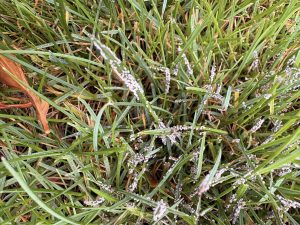
Slime mould appears in two stages. The first is the active plasmodial stage: a slimy, viscous mass creeping across the lawn surface. It can be yellow, orange, white, grey or purple depending on the species. It moves slowly but visibly, which is disconcerting the first time you see it.
The second is the fruiting stage: crusty or powdery patches on grass blades and at the soil surface, often grey, black or white. Looks like the lawn has been dusted with ash or fine powder.
Both stages are temporary. The whole episode typically runs two to three days before the slime mould disperses naturally and releases its spores. Your lawn comes through with no lasting damage.
The one minor effect is temporary shading. Where slime mould sits on grass blades for several days, it blocks some light. You might see slight yellowing in the covered area. It recovers within days once the slime mould moves on.
Why it appears
Warm damp conditions plus available organic matter. It comes out of the soil or thatch after warm summer rain, particularly in shaded spots that stay moist longer, in areas with heavy thatch, or near garden mulch where spores are plentiful. It’s most common through summer and early autumn. Some lawns get it regularly in the same spots year after year because the conditions there are consistently right for it.
What to do
Hose it off. A strong jet from a garden hose knocks the slime mould off the grass blades in minutes. It flushes down into the soil where it carries on its life cycle without being visible. That’s the standard approach and it works immediately. If you’d rather wait, it disperses on its own within a few days. The lawn doesn’t care either way.
For the dried fruiting stage, a light rake lifts the crusty residue off the surface. Bag the rakings rather than composting near the lawn.
What not to do
Don’t apply fungicide. Slime mould isn’t a fungus and fungicides have no effect on it. Wasted product, wasted money, and unnecessary chemistry on the lawn.
Don’t dig out the soil around it. The slime mould isn’t anchored in the soil the way a fungal pathogen would be. The soil isn’t infected. Digging creates unnecessary disturbance.
Don’t stress about it. This is the easiest lawn problem you’ll encounter. Hose it off and move on.
If it keeps coming back
Same spots getting slime mould every summer points to persistently damp conditions combined with heavy thatch or nearby organic matter. Reducing thatch through periodic scarifying, improving drainage where practical, and being careful with garden mulch near lawn edges all reduce recurrence. But for most home lawns, slime mould appears occasionally, gets hosed off, and that’s the end of it.
Comments
0